

What causes a bad acid trip?
A bad acid trip is almost never the acid. On a tab that holds LSD, a hard night comes from the state you took it in and the place you took it, and the drug did what it always does, in the wrong conditions.
The one exception is a tab that was never LSD. A reagent settles that in about a minute, before anything is taken, and it is the only part of a bad trip you can rule out in advance.
In short
- A bad trip is anxiety, panic, thought loops, old trauma surfacing, confusion, or an injury from acting on any of those. The body is almost always fine.
- It is a normal part of psychedelics. About one LSD user in a hundred seeks medical help in a year, nearly always for panic, and most are back to normal within a day.
- On a real tab the cause is set and setting: your mood, sleep, expectations and medication, and the place and people around you.
- Mixing drugs is one of the main triggers, and cannabis leads the list.
- The one cause you can rule out in advance is a tab that was never LSD. A reagent answers that in a minute.
What a bad trip is
“Bad trip” covers several different nights. Most of them are psychological, and the body is fine throughout.
- Anxiety that will not settle. A feeling that something is wrong, with nothing to attach it to.
- A panic attack. Racing heart, shallow breathing, the certainty that you are dying or losing your mind. On LSD it can last for hours instead of minutes.
- Thought loops. The same thought, or the same minute, repeating with no way out. The feeling that it will never end is part of the loop.
- Old material surfacing. Grief, a past assault, a death. The drug lowers the door and whatever was behind it walks in.
- Paranoia and confusion. Not knowing where you are, who the people around you are, or whether you took anything at all.
- Injury. Walking into traffic, a fall, a fight, cold exposure. The trip did not hurt anyone. Acting on it did.
The last one is the only one that lands people in hospital with something a doctor can treat. The rest are frightening and pass.
How common it is
In the Global Drug Survey, one in a hundred people who had taken LSD in the past year sought emergency medical help, which works out at about one event in five hundred. The problems they reported were nearly all psychological: anxiety, panic and confusion. The reasons they gave were a poor setting and a poor mindset. Most were back to normal within a day.[1]
A Johns Hopkins survey asked two thousand people about their single worst psilocybin experience. Four in ten rated it among the five hardest things they had ever been through. One in ten had put themselves or someone else at physical risk. Fewer than three in a hundred got medical help. Eight in ten still said they benefited from it.[2]
Those are other people’s nights, and the second survey only asked people who had already had a bad one. What both show is that a hard trip is a normal part of psychedelics, and that the body almost always comes through it untouched.
Why it is usually not the compound
The forum reflex after a rough night is to blame the batch. The tab must have been cut, or weak, or high in iso-LSD. Nearly every one of those explanations fails on the chemistry.
A blotter square holds about a tenth of a milligram of anything, so a tab cannot be cut in any way that matters. Iso-LSD does nothing at any dose anyone has tested. Strychnine on blotter has never been found in a street sample. Drug-checking results for LSD blotter come back as LSD far more often than anything else, and the rough nights on those tabs still happen.
The term for what actually causes them is set and setting. Set is everything you bring: mood, sleep, expectations, what you are carrying, what else is in your blood. Setting is everything around you: the room, the people, the noise, whether you can leave. The idea is older than LSD and has held up through every decade of research since.[3]
Set: what you bring
Mood and sleep. Acid amplifies what is already there. Anxious going in, exhausted, or carrying something you have been avoiding, and the trip finds it.
Expectation. Taking it to fix something, to prove something, or because everyone else did, sets the trip up as a test. Tests get failed.
Medication. Lithium with LSD causes seizures and is the one combination with a record of real harm. SSRIs and other antidepressants dull or unpredictably change the trip. Tramadol lowers the seizure threshold. If you take anything daily, check it first.
Mixing drugs. One of the most common causes, and cannabis leads the list. A joint during the come-up or the peak can turn a steady trip into thought loops and panic within minutes, and people who smoke daily without trouble are not protected. THC amplifies the acid and brings its own anxiety on top. Alcohol blurs judgement and leads to the falls and the traffic. Stimulants push the heart rate and the dread. Take the tab on its own, and if you want to smoke, wait until the acid is clearly on the way down.
Dose. The one thing on the paper that does matter. Higher doses produce harder trips in every survey, and a tab from an unknown sheet has an unknown dose. A reagent does not read micrograms. A laboratory does, in micrograms per blotter.
Setting: where you are
Place. Somewhere you can sit, lie down, be warm and be left alone. A festival crowd at 3 a.m. has none of that.
People. One person you trust who is sober, or at least steadier than you. Strangers and anyone you are trying to impress go on the other side of the ledger, and so does an argument.
An exit. Knowing you can leave, lie down or turn the music off is often enough that you never need to.
Time. Acid runs eight to twelve hours. Starting at midnight means the hard part lands at dawn, when you are cold and tired.
When it is the compound
Some tabs are not LSD, and those nights look different. NBOMe tabs taste bitter and metallic, and the trip is physical: a pounding heart, high blood pressure, muscle tension, in the worst cases seizures and deaths. DOC and DOB tabs run for a day or more and come up slowly, so people redose and then cannot get off.
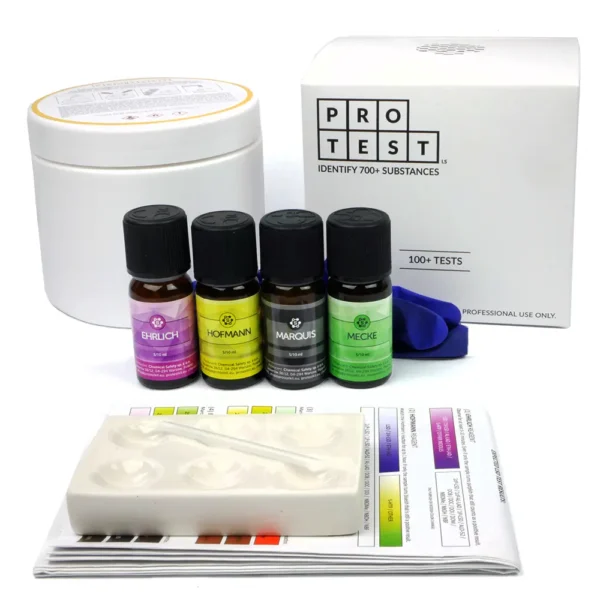
A reagent catches both before anything is taken. Ehrlich turns purple for LSD and stays blank for NBOMe and DOC. Hofmann adds a second colour that separates LSD from most other lysergamides. The test takes a minute and answers the one question a bad trip cannot: whether the paper was acid at all.
The table below lists the usual causes of a bad trip, what each one looks like, and what helps.
| Cause | Looks like | What helps |
|---|---|---|
| Anxious or tired going in | Dread with no object, loops | Not taking it that day |
| Bad place or company | Paranoia, wanting to leave | Leaving, a quiet room, one calm person |
| Too high a dose | Losing track of self and place | Lower dose next time, lab result for the sheet |
| Cannabis or other drugs on top | Sudden loops and panic, usually after a joint | Taking the tab on its own |
| Medication on board | Seizure risk, flat or strange trip | Checking interactions first |
| Not LSD at all | Bitter tab, physical symptoms, 24 h duration | Reagent test before taking it |
What to do while it is happening
The Zendo Project has sat with thousands of people through hard trips at festivals and works from four rules.[4]
- Make the space safe. Somewhere quiet and warm, away from the crowd. Water. A blanket.
- Sit, do not guide. Stay with the person. Let them lead. You do not need to fix anything.
- Talk through, not down. Do not try to end the trip or argue them out of it. Remind them what they took, that it wears off, and that you are staying.
- Difficult is not the same as bad. Most hard trips turn into something useful afterwards, and treating one as an emergency makes it worse.
Call for help when the body is in trouble: a seizure, chest pain, a temperature that will not come down, a fall, or someone who cannot be kept safe from traffic or heights. Emergency rooms treat these with a benzodiazepine and a quiet room, and nobody there cares what you took.
References
- Kopra EI, Ferris JA, Winstock AR, et al. Adverse experiences resulting in emergency medical treatment seeking following the use of lysergic acid diethylamide (LSD). Journal of Psychopharmacology, 2022. Global Drug Survey data on 10,293 past-year LSD users. ncbi.nlm.nih.gov ↩
- Carbonaro TM, Bradstreet MP, Barrett FS, et al. Survey study of challenging experiences after ingesting psilocybin mushrooms: acute and enduring positive and negative consequences. Journal of Psychopharmacology, vol. 30, no. 12, 2016, pp. 1268 to 1278. doi.org ↩
- Hartogsohn I. Constructing drug effects: a history of set and setting. Drug Science, Policy and Law, vol. 3, 2017. doi.org ↩
- Zendo Project. Four principles of psychedelic care. zendoproject.org ↩
LSD harm reduction guide · What is iso-LSD? · What Ehrlich reagent shows · What does LSD look like?
Questions?
Can a bad trip be caused by a bad batch?
Only if the batch was not LSD. On a tab that holds acid, the batch explains the dose and nothing else. The night came from set and setting.
Does iso-LSD cause bad trips?
No. It has no measured effect at any dose. A tab high in iso-LSD is a weak tab, and a weak tab does not cause panic.
Does smoking weed on acid cause a bad trip?
Often, yes. Cannabis is the most common thing people add mid-trip, and it is the most common thing they name afterwards when the trip turned. If you want to smoke, wait for the comedown.
How long does a bad trip last?
As long as the acid does, so up to twelve hours, though the hard part usually passes in one or two. If it is still going after a day, the tab was probably not LSD.
Can you die from a bad acid trip?
Not from the LSD. Deaths come from accidents during the trip, from combinations such as lithium, and from substitutes such as NBOMe. A reagent rules out the last one in a minute.
Will a reagent test prevent a bad trip?
It tells you whether the tab is acid. That removes the only cause you can remove in advance. The rest is who you are that day and where you are.
No test result can tell you a substance is safe. No substance is 100% safe.This article is published for harm reduction purposes. It does not encourage the use of psychoactive substances and does not replace medical advice.